Hi Giacomo! Nice that you are participating in our “Meet the Student”! Please tell us something about yourself.
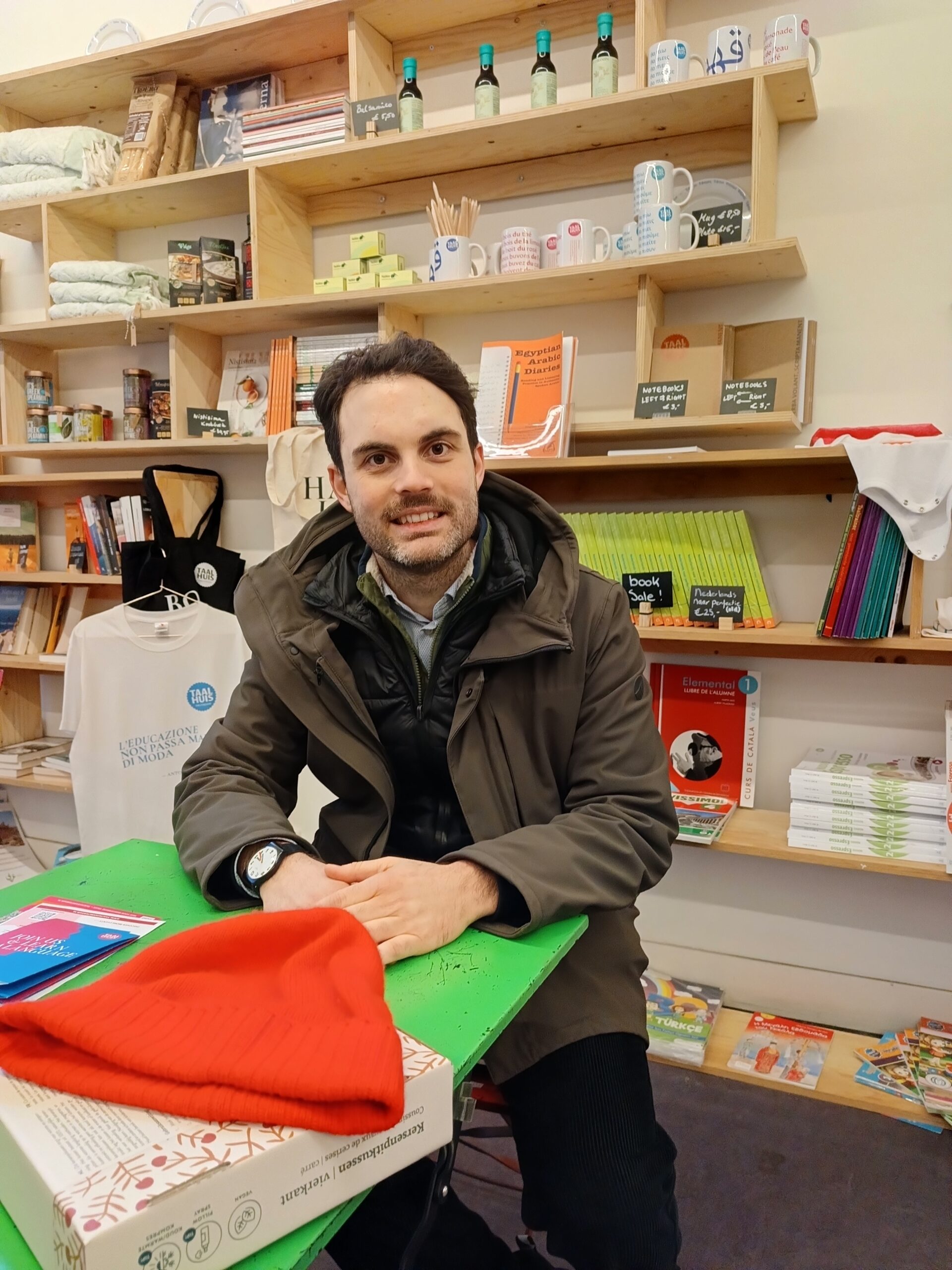
My name is Giacomo. I am from Italy. I have been living in Amsterdam since 2018. I came here to study information law. Protection of personal data is my specialty. I met my Dutch wife five years ago. We now have a child together. So, I think that the Netherlands has become a somewhat longer project for me.
When did you start learning Dutch?
I started taking language lessons when my wife became pregnant. The Netherlands has also become my home now, and learning its language well is the most important thing for me personally. But the language is also important to be able to live here and to really enjoy the possibilities of the city and the country.
Which languages do you speak?
In addition to Dutch, I speak Italian and English. English was at first my working language. But now I work at ING. They are an international company, but it’s also ‘orange’, therefore we have many Dutch customers. Dutch is also my first language at work now. My wife is now starting to learn Italian. We are a bilingual family.
How did you end up at Taalhuis Amsterdam?
I actually don’t know anymore how exactly. But I have been taking courses at Taalhuis for a long time. That’s because the teachers are enthusiastic and passionate about their work, languages and culture. I always have the feeling that the teachers are curious about the students and their background. I like the intercambios, and of course the events as well. I think these are really unique to Taalhuis.
Which course have you taken recently?
My last course was in December, the debate club. That was super fun. Suitable for my level: giving longer presentations and having debates. I think that the debate culture is also typical for the Netherlands. Italy is more of a hierarchical country. The older you get, the more important you are there. It’s a bit more democratic here. Everyone has something to say. That’s not just a perception of mine. Children are actually taught this at school. In Italy, children are not trained in this; they learn to listen well. That is of course also important. But it creates a different kind of society. The Netherlands is truly a democratic country.
What’s the most effective part of the class?
The conversations with fellow students. Where they come from, what their motivation is for learning the language, what strategy they use. At the same time, lessons alone are not enough to learn the language. You also have to do it yourself. Going to school every week provides a lot of structure. That’s what I like about taking classes: the commitment. It’s not like something magical happens during the lessons and you suddenly learn the language. It’s a process, and the school is an important part of that process.
How do you approach learning Dutch outside of the lessons?
The most important thing is that you find something interesting. In the country, in the media, in a good newspaper or a TV program. Personally, I am interested in politics and in debates. And in the last five years there have been elections here two or three times. That certainly helped!
So, you actually learned Dutch through politics…
Yes. I also think that the way politicians debate with each other is a good way to learn the language. And the culture, what’s important for the people and for the country, what’s going on. So if you find politics interesting, that’s a good way.
What do you find difficult about Dutch?
The word order is a nightmare for me. And also the pronunciation of certain words. As an Italian, I just can’t hear certain sounds clearly. For example, the difference between W and V. In Italian there is no ‘W’. It’s not in our alphabet. We have a somewhat shorter alphabet.
And is it easy to speak Dutch with people you meet?
People quickly start speaking English with you. That’s a bit of a pity. Not only for foreigners but also for the Dutch themselves. There is an advantage and a disadvantage to being a bilingual city. The advantage is that it’s a very open and attractive city.
I understand that there are two levels of integration. The first level is the international city. Speaking English is no problem here, everyone is welcome. The second level of integration is: Sinterklaas songs, the schools, the tax authorities, the talks with your child’s teachers. And everything happens at that second level in the Netherlands.
And you are now in that second layer?
Pretty much! My message for all foreigners is that the second layer can be very nice. There is so much to find there! If you have lived here for ten years and you do not enter the second layer of society, you’re missing out. The language itself is not the goal. Language is a means to connect with the people, the country and the society.
Nice advice! Do you have any other tips for people who want to learn Dutch?
Decide as quickly as possible whether you want to continue living here. I know many foreigners who have lived here for years, but still see it as a little bit of a temporary situation. Like: I live here, I have a job here, but I might leave again. Of course, that can always happen, it’s different for everyone. But I would choose as soon as possible whether this will be your home or not. And if that is the case, then you have to work for it. Invest in it. I will be taking my NT2 II state exam (B2 level) in April, also to make it official.
That is also a good aspect of Taalhuis Amsterdam. They offer different types of courses. The more traditional form, grammar and all that; that’s important. But also other things, such as the debate club, the book club, or just a workshop. So for the next four or five years, Taalhuis will always remain a possibility for me.